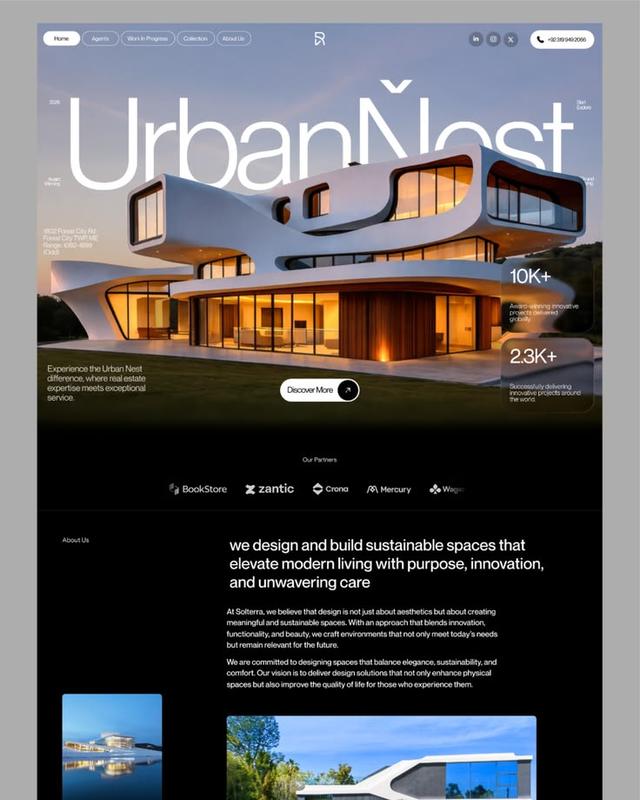
urbannest.studio

Course delivery, assessment, and analytics designed around completion rates rather than content storage — because an LMS nobody finishes is an expensive filing cabinet.
Designed around finishing, not just enrolling.
Content that responds to how each learner is doing.
Cohort data that tells you where people drop off.
Standards-compliant, so your content stays portable.

An LMS fails when it is designed for whoever bought it. Learners, instructors, and administrators each need their own view of the same system.
Picked up exactly where they stopped, on any device, with progress synced.
Gentle habit mechanics that nudge without turning learning into a slot machine.
Clear sense of what is left, so the finish line always feels reachable.
Across three active cohorts, with per-cohort pacing visible at a glance.
Queued submissions with rubric-based marking and reusable feedback snippets.
Flagged automatically where a cohort stalls, so content gets fixed early.
Provisioned automatically from your HR system or identity provider.
Mandatory training tracked with automated reminders and escalation.
SAML and OIDC with SCIM provisioning, so leavers lose access the same day.
Industry completion rates for self-paced online courses sit somewhere between 5% and 15%. These five moments are where the losses happen, and each one is a design problem.
Most learners who abandon a course do so before finishing the first module. The fix is structural: a genuine win inside the first ten minutes, no setup friction, and an obvious next action rather than a content library to browse.
The point where difficulty first exceeds confidence is the second cliff. Adaptive sequencing matters here — a failed checkpoint should route to targeted support, not push the learner onward while quietly losing them.
Halfway through, the novelty is gone and the certificate is still distant. Progress visibility, streaks, and cohort presence all measurably help — but only when they reflect real progress rather than manufacturing false urgency.
Learners stall before a graded assessment more often than they fail one. Low-stakes practice attempts, clear rubrics published in advance, and a visible retake policy remove most of that hesitation.
Finishing is not learning. Spaced reinforcement, refresher prompts, and on-the-job reference material are what turn a completion certificate into retained capability six months later.
 Learner experience
Enrolment is a vanity metric that most platforms optimise for because it is easy to move. We build for the harder number: the percentage of people who start something and actually complete it, which is the only figure that correlates with the outcome you bought the platform for.
The modules most platforms need. Which of these you actually get built depends entirely on what your learners require.
Structured pathways with video, documents, SCORM packages, and interactive blocks — sequenced or free-choice.
CoreQuizzes, assignments, peer review, and proctored exams with question banks and randomised delivery.
CoreContent that branches on performance, so struggling learners get support and strong ones skip ahead.
EngagementVerifiable certificates, expiry tracking, renewal reminders, and digital badges that survive verification.
ComplianceCohort funnels, question-level item analysis, and scheduled exports for stakeholders who live in spreadsheets.
InsightDiscussion, group projects, and peer feedback — the parts that make completion rates rise most reliably.
EngagementSCORM, xAPI, LTI, plus HRIS and CRM sync so enrolment and completion flow both ways automatically.
IntegrationSSO, SCIM provisioning, GDPR/FERPA handling, audit logs, and data residency where regulation requires it.
GovernanceDraft generation for authors, automated summaries, and a tutor that answers from your material with citations.
OptionalTypical improvement over the content-library platforms we replace.
Peak load handled on platforms we have built and operate.
AA compliance verified with assistive technology, not just automated checks.
Including exam periods, when availability matters most of all.
 Authoring tools
If publishing a course update requires filing a ticket, courses stop getting updated. Authoring belongs to the people who know the subject, with version control and review workflows underneath so that autonomy does not become chaos.
Moodle and Canvas are genuinely good, and off-the-shelf is often the right call. Custom is worth it in specific circumstances — here is how to tell which you are in.
| Off-the-shelf | Custom build | |
|---|---|---|
| Time to first cohort | 2-6 weeks | 3-6 months |
| Upfront cost | Low | Higher |
| Per-seat licence cost at scale | Grows with seats | Flat |
| Matches an unusual pedagogy | ||
| Deep integration with your systems | Limited | |
| You own the roadmap | ||
| Full control of learner data | ||
| White-label as your own product | Limited |
Our rule of thumb: if a standard platform covers 80% of what you need, take it and live with the 20%. Custom earns its cost when the LMS is your product, when per-seat licensing at your scale exceeds the build, or when your teaching model simply does not fit the boxes an off-the-shelf platform provides.
An LMS does not have a content problem. It has a finishing problem — and no amount of uploaded video has ever solved it.
What we design againstRich multimedia course delivery with structured learning pathways, not a folder of static PDFs.
Real engagement and completion data, so you know what's working and what learners are skipping.
Personalized pacing and recommendations that adapt to each learner instead of a one-size-fits-all course.
The practical questions from people who have usually been burned by an LMS before.
Very possibly, and we will say so if that is our honest read. Off-the-shelf platforms are mature, cheap to start, and cover the common cases well. Custom makes sense in three situations: the LMS is the product you are selling rather than an internal tool, per-seat licensing at your scale has grown past what a build would cost, or your teaching model genuinely does not fit the structures those platforms impose. Outside those, the standard platform usually wins.
Yes. SCORM 1.2 and 2004 packages, xAPI statements, and most common export formats import directly. Learner records, completion history, and certificates migrate too — that part is usually more delicate than the content, because completion data often has compliance significance and cannot simply be approximated.
Structurally, not with gamification sprinkled on top. The measures that move the number are: a real win inside the first session, adaptive support at the first difficult moment, visible progress throughout, low-stakes practice before graded assessment, and social presence so learners are not working alone. We instrument the funnel so you can see which stage is losing people and fix that specific stage rather than guessing.
Yes, and for many learner populations that is the primary experience rather than a fallback. Video downloads for offline viewing, progress queued locally and synced when a connection returns, and layouts designed for a phone first rather than a desktop layout squeezed down.
WCAG 2.2 AA is the baseline, tested with actual screen readers rather than only automated tooling. For regulated environments we handle GDPR and FERPA data requirements, immutable audit trails, and data residency. Compliance reporting is built as a first-class feature, because retrofitting an audit trail afterwards is painful and sometimes impossible.
A focused platform for a defined audience is typically three to four months; a multi-tenant product with authoring, assessment, and deep integrations runs six months or more. Cost tracks scope rather than seat count. We scope in phases so that a usable platform reaches real learners early and later phases are funded on the strength of what the first one demonstrated.
Tell us about your courses and learners — we'll show you how we'd structure the platform.
I’m looking for:
We usually reply within one business day.