


An AI agent in real estate is software that takes actions on a brokerage's behalf — qualifying an inbound lead against real criteria, booking a showing on a live calendar, updating the CRM, and running follow-up until someone answers — rather than simply replying to questions like a chatbot does. That distinction is the whole subject of this article, because it is the one most brokerages are not being sold clearly.
The argument about whether to adopt AI in real estate is over. The interesting question now is narrower and much more useful: what should you actually point it at, and where should it stop?
Adoption is no longer the story
In Delta Media Group's annual survey of over 100 US brokerage leaders, the share of brokerages using no AI at all fell from 24.8% in 2024 to 3.9% in 2026. The share with no plans to adopt it fell from 10.6% to 1.9%. Nearly half of brokerage leaders (47.6%) now rate AI's importance at 8 or higher out of 10, up from 28.7% the year before.
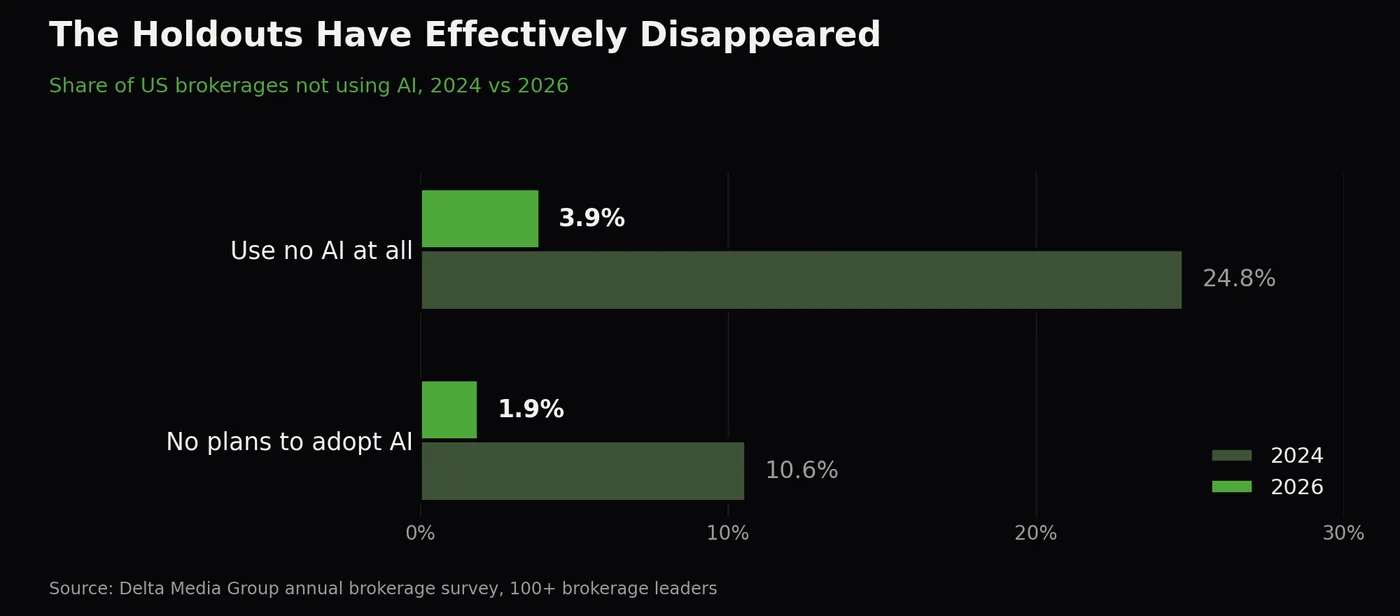
Read that carefully, because it changes what "having AI" is worth. When 96% of your competitors have adopted something, adopting it is no longer an advantage — it is table stakes. The advantage moves to what you point it at. And most brokerages have pointed it at content generation: listing descriptions, social captions, email drafts. Useful, but it is the part of the business that was never losing them money.
What is the difference between a chatbot and an AI agent?
A chatbot answers. An agent acts. A chatbot responds to questions inside a chat window using scripted or generated replies, and stops when the window closes. An AI agent has access to your systems and permission to do things in them: it can check a calendar, write a record, send a message tomorrow morning, and decide that a particular conversation now needs a human.
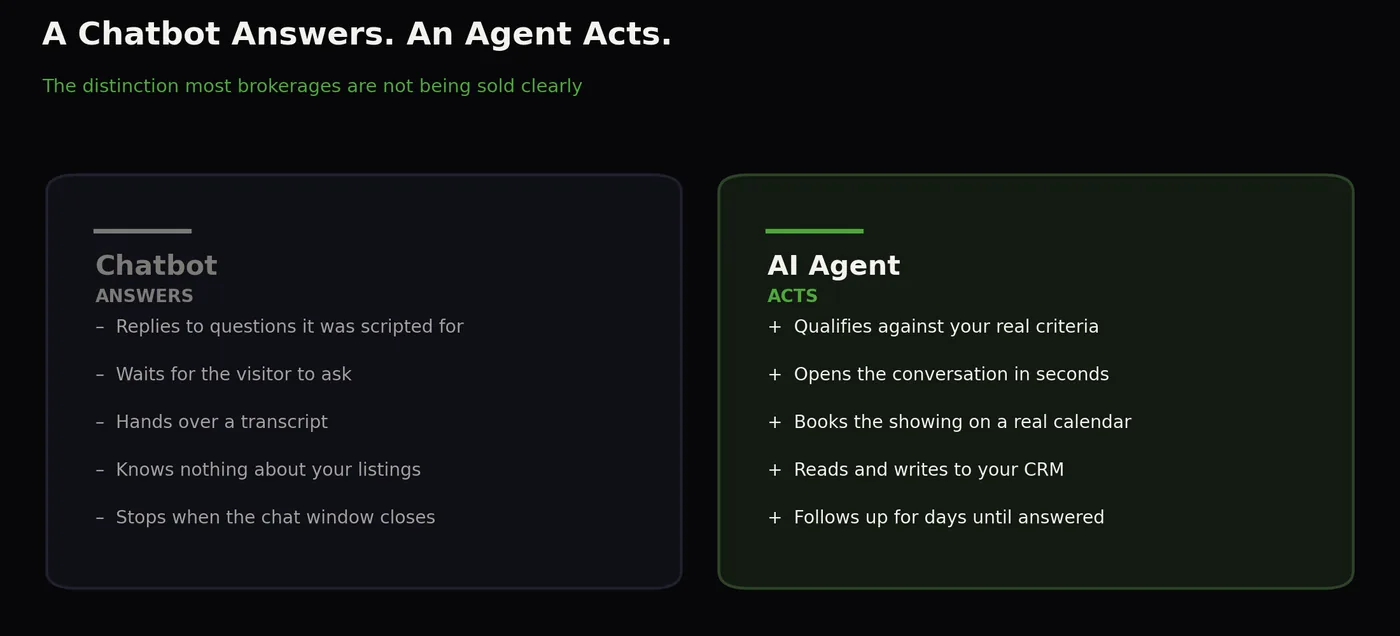
The practical difference shows up in a single number: the gap between an enquiry arriving and something useful happening. A chatbot narrows that gap only if the visitor is still on the page. An agent closes it regardless — including at 11:40pm on a Sunday, which is when a meaningful share of property browsing happens.
Why response speed is the whole game
The case for agents in real estate does not rest on the technology being impressive. It rests on four numbers about inbound leads:
- 78% of buyers work with the first agent who responds to their enquiry, according to the National Association of Realtors. Not the best agent. The first one.
- Responding within five minutes converts roughly 21× better than responding within thirty (Real Trends / InsideSales).
- The average agent takes over 15 hours to make first contact (Inman). Response rates fall by a factor of ten after the first hour (MIT).
- 44% of agents stop after one follow-up attempt, while leads receiving six or more touchpoints convert about 70% better.
Put together, these describe a problem that no amount of hiring solves cleanly. Your agents are asleep at 11:40pm, and they should be. The failure is structural, not personal — and structural failures are exactly what software is good at.
What AI agents actually do for a brokerage
Here is the honest, specific list — the tasks we see genuinely work in production, rather than the ones that demo well:
- Instant first response, every hour of the day. Every enquiry gets a real reply within seconds, which puts you in the 78% bracket by default rather than by luck.
- Qualification against your criteria. Budget, timeline, financing status, area, whether they have a property to sell first. The agent asks what a good agent would ask, and scores the lead before anyone opens a laptop.
- Showing scheduling on a live calendar. Not "someone will be in touch" — an actual booked slot, with the conflict checking done.
- Persistent, structured follow-up. The six-plus touchpoint sequence runs automatically and stops the instant a human takes over or the lead asks it to.
- Routing with context attached. The right agent gets the lead with the full conversation, not a notification saying a form was submitted.
- CRM read and write. Every interaction lands in your system of record automatically. An agent that cannot write back to your CRM creates more work than it removes.
- Listing questions answered from real data. Square footage, HOA fees, days on market, school zone — pulled from your listing data rather than improvised.
What AI agents can't do — and shouldn't
This is the section most vendors leave out, and it is the one worth reading twice. A well-scoped agent has hard boundaries:
- It should not negotiate. Price, terms, and concessions are judgement calls with legal and financial consequences. This is a human's job and should stay one.
- It should not give legal, financial, or investment advice. Beyond the compliance exposure, it is the fastest way to destroy trust with a client who knows more than the model does.
- It should not pretend to be human. Deceiving a prospect about who they are talking to is both an FTC risk and, more practically, something people find out and resent. Say it is an assistant. Buyers largely do not mind — they mind being lied to.
- It cannot replace domain judgement. Reading that a family is anxious about a school catchment, or that a seller is not actually ready to sell, is not a qualification field. It is why the handoff exists.
- It is only as good as your data. An agent pointed at a stale listing feed or a CRM nobody maintains will confidently repeat bad information faster than a human ever could.
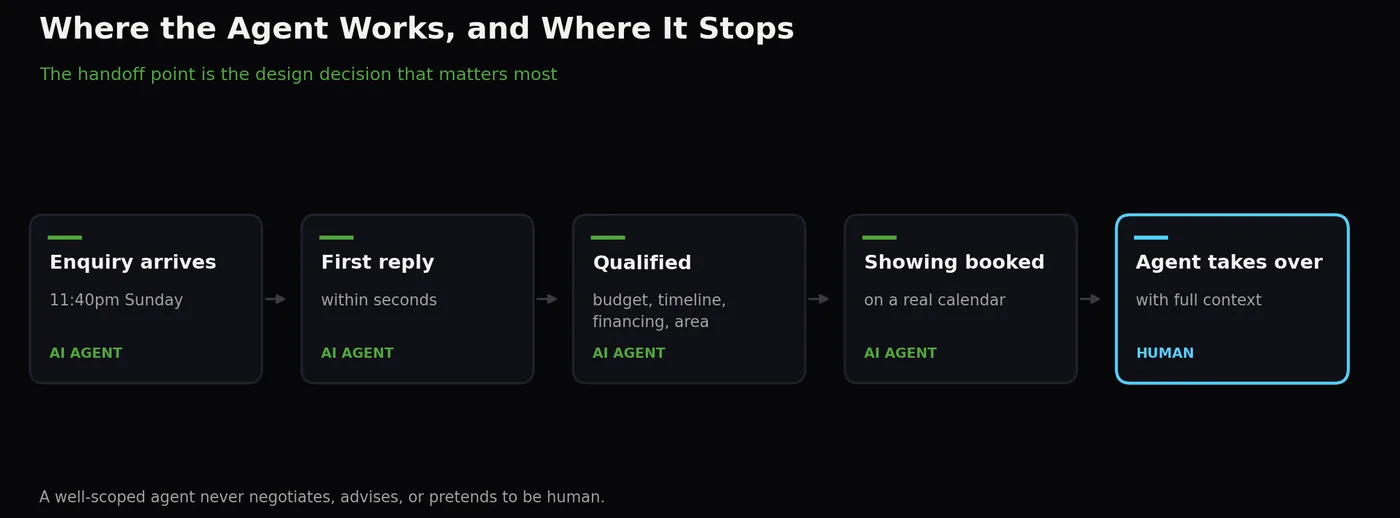
The handoff point is the single most important design decision in the whole system. Set it too late and you frustrate serious buyers who wanted a person three messages ago. Set it too early and you have built an expensive contact form. The right answer is usually earlier than the vendor selling it to you suggests.
What implementation actually involves
Three things determine whether an agent project succeeds, and none of them are the model:
1. CRM integration. This is checked first, before anything is scoped. Most major real estate CRMs expose APIs that allow an agent to read and write leads, notes and activity. Some do not, or do so badly. If yours cannot be written to, that constrains the entire design and you want to know on day one rather than in week six.
2. Your qualification rules, written down. The hardest part of these projects is rarely technical — it is getting a brokerage to articulate what actually makes a lead worth an agent's time. That conversation is uncomfortable and it is where most of the value is created.
3. The escalation path. Who gets the hot lead, how fast, on what device, and what happens if they do not respond. An agent that qualifies brilliantly and routes into a void has moved the bottleneck, not removed it.
On timeline and cost: a focused agent handling first response and qualification for a single lead source is typically a matter of weeks rather than months. Scope grows with the number of workflows automated and the number of systems it has to talk to, which is why we scope against your actual workflow rather than quoting a package price.
Frequently asked questions
What is an AI agent in real estate?
An AI agent is software that takes actions on a brokerage's behalf rather than only answering questions. In practice it responds to an inbound enquiry within seconds, qualifies the lead against the brokerage's criteria, books showings on a real calendar, updates the CRM, and escalates to a human agent when the conversation warrants it.
How is an AI agent different from a chatbot?
A chatbot replies to questions inside a chat window and stops when the window closes. An AI agent has access to the brokerage's systems and can perform actions in them — checking calendars, writing CRM records, sending follow-ups days later, and deciding when to hand a conversation to a person.
Will an AI agent replace real estate agents?
No. It replaces the gap between a lead arriving and a human responding to it. Negotiation, advice, judgement and the relationship itself remain human work. The realistic effect is that agents spend their time on qualified leads instead of losing three out of four before anyone picks up the phone.
Do AI agents work with existing real estate CRMs?
In most cases, yes. The major real estate CRMs expose APIs that let an agent layer read and write leads, notes and activity. Integration effort varies by platform, and confirming it is the first step before scoping any project — an agent that cannot write back to your system of record creates more work than it removes.
Should an AI agent tell people it is not human?
Yes. Disclosing that a prospect is speaking with an AI assistant is both the lower-risk position and the more effective one. Buyers are largely comfortable with an assistant handling the first response; what damages trust is discovering they were misled about it.
How much does an AI agent for real estate cost?
It is scoped against how many workflows it automates and how many systems it must integrate with, rather than sold as a fixed package. A focused agent covering first response and qualification for one lead source is a matter of weeks to build; a full platform handling multiple sources, routing rules and transaction support is a larger engagement.
What is the biggest mistake brokerages make with AI agents?
Pointing them at content generation instead of response time. Listing descriptions and social captions were never the part of the business losing money. The measurable loss sits in the hours between an enquiry arriving and a human answering it.
Building this with Design World Studio
We build AI matching and routing systems as our core work — CrewIQ matches workers to shifts, Unbroken Investing matches investors to deals, ZipTrip matches travellers to itineraries. Routing a property enquiry to the right agent before it goes cold is the same shape of problem, which is why real estate is where we focus.
If you want to know whether this is worth doing for your brokerage, the fastest test costs nothing: submit an enquiry through your own website the way a buyer would, and time how long it takes to get a real reply. That number is the size of the opportunity. Tell us what it was and we will tell you honestly whether an agent is the right fix, or whether something simpler would do.