Choosing a mobile app development company comes down to five things you can actually verify: whether they scope before they quote, who specifically will write your code, what happens to the code if you leave, how they handle the work after launch, and whether they have shipped something genuinely comparable to what you are asking for. Everything else on a typical agency website — awards, badges, client-logo walls — tells you nothing you can check.
This guide is written from the other side of the table. We are a development studio, so read it with that in mind. What you will not find here is a list with us at the top.
Why "top 10" lists will not tell you who is right for you
Search for the best mobile app development companies and you get two kinds of result, and it is worth knowing how each one is produced.
- Directory rankings. Platforms like Clutch rank partly on verified client reviews, which is genuinely useful, and partly on factors an agency can influence through paid placement and profile activity. A high position tells you a firm is investing in that channel. It does not tell you they are right for your project.
- Agency-written listicles. The majority of "Top 10 Mobile App Development Companies" articles are published by agencies who appear on their own list. It is marketing content wearing the costume of a review.
Neither is dishonest, exactly. Both are just answering a different question than the one you are asking. You are not looking for the best agency in the world. You are looking for the right agency for one specific project, at your budget, in your industry. That is a shortlist of three or four firms, and no published list can produce it for you.
USA, nearshore, or offshore? What the rates really look like
This is usually the first real decision, and it is worth having actual numbers rather than instincts. Published 2026 market data puts blended rates in roughly these bands:
- US agencies: around $205–$340/hr for a mid-level developer once project management and overhead are included. Individual US contractors sit closer to $108–$165/hr mid-level, $140–$210 senior.
- Eastern Europe: roughly $64–$97/hr — about 41% below US agency pricing.
- Latin America (nearshore): roughly $56–$86/hr, with the significant advantage of overlapping work hours.
- Southeast Asia: roughly $47–$73/hr.
- South Asia: roughly $24–$36/hr mid-level.
The honest read: rate is the least reliable predictor of what a project ends up costing you. A $40/hr team that needs three attempts at the same feature costs more than a $120/hr team that gets it right once, and the gap widens every month the app is in maintenance. What actually drives your total is scope discipline, how senior the people on your project really are, and how much rework happens.
Where location genuinely matters is time zones and communication. A four-hour overlap and a shared working vocabulary are worth real money on a project with weekly decisions. A twelve-hour gap with asynchronous handoffs is workable, but only with a team that has genuinely built the process for it — and most claim they have.
Five questions to ask before you sign anything
Ask these on the first call. The answers separate firms faster than any portfolio.
1. "Who exactly will write my code, and can I meet them?" The single most common disappointment in agency work is the senior team on the sales call being replaced by juniors after signature. Ask for names, ask to meet them, and ask to have the core team written into the contract. A firm that will not name the people is telling you something.
2. "Walk me through how you arrived at this number." A real estimate decomposes into features, roles and hours, with assumptions stated and risks flagged. A single figure with no breakdown means either they have not thought about it or they are not going to tell you — and both end the same way, with change requests.
3. "Who owns the code and the accounts?" You should own the repository, the App Store and Play Console accounts, the domain, and every third-party service registered in your name. Get it in writing. The alternative is discovering at the worst possible moment that leaving means rebuilding.
4. "What happens the day after launch?" Apps are not finished at launch — that is when the OS updates, crash reports and real users begin. Ask what post-launch support costs, what response times look like, and whether the same people stay on it. Budget for it as part of the project, not as a surprise.
5. "Show me something like mine that is live, and tell me what went wrong on it." Anyone can show a polished case study. The useful part is the second half of the question. A team that can describe a real problem they hit and what they changed is a team that has actually shipped. A team with only smooth stories has either not shipped much or is not being straight with you.
Red flags worth walking away from
- A fixed price before any discovery. Nobody can responsibly price software they have not scoped. A fixed number on day one means padding, a thin scope that will generate change orders, or both.
- A portfolio with no named clients. "A leading fintech company" usually means the work cannot be verified. Ask for one reference you can call.
- Guaranteed App Store featuring, downloads, or rankings. Nobody controls these. This is the clearest single signal that the rest of the pitch is unreliable.
- No questions about your users. If the first conversation is entirely about features and never about who uses this and what they are trying to do, you are buying a build service, not a partner.
- Pressure to sign this week. Discounts that expire are a sales tactic, not a commercial reality. Good teams have a pipeline and can wait a fortnight.
- Vague answers on testing and security. Ask specifically how they handle authentication, data storage, and what their QA process is. Hesitation here is expensive later.
What a real proposal looks like
When you have your shortlist, compare proposals on structure rather than on the bottom-line number. A proposal worth trusting contains:
- A restatement of your problem in their words — proof they listened, and the cheapest test of whether they understood.
- A feature list split into what is in scope now and what is explicitly deferred.
- Named roles with rates and estimated hours, not a lump sum.
- Stated assumptions and the top three risks, with how each would be handled.
- A delivery plan with something demonstrable in the first few weeks, not one reveal at the end.
- Ownership, licensing and post-launch terms in plain language.
If two proposals differ by 40%, the difference is almost never efficiency. It is scope. Put them side by side feature for feature and the gap usually explains itself.
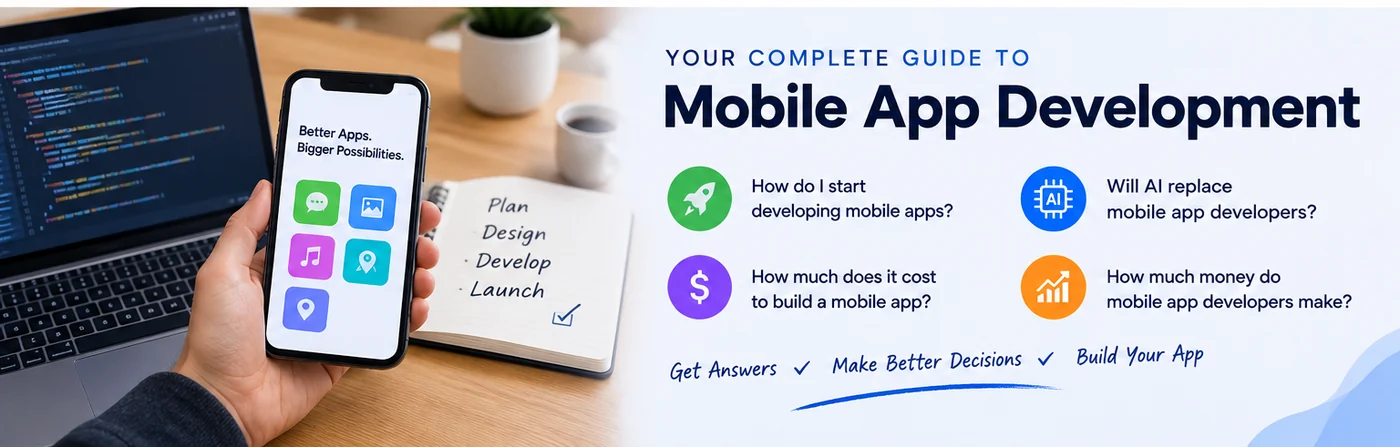
Frequently asked questions
How do I start developing a mobile app?
Start with the problem rather than the app. Write down who has it, what they do today instead, and what would have to be true for them to change. Then define the smallest version that solves it end to end for one type of user — that is your first build, and it should be measured in weeks. Only after that is validated do you decide platforms, stack and scale. Most failed apps were not built badly; they were built confidently for a need nobody had confirmed.
How much does it cost to build a mobile app?
A focused MVP with a handful of core features typically lands in the tens of thousands; a full-featured consumer or business app with integrations, multiple user roles and a backend runs well into six figures. The cost drivers are the number of integrations, whether you need native builds for both platforms or one cross-platform codebase, permission complexity, and how much design is bespoke. Our detailed breakdown of 2026 pricing is in the mobile app development cost guide.
Will AI replace mobile app developers?
Not on the current evidence, though it has changed what developers spend their time on. Stack Overflow's 2025 survey found roughly 92% of developers use an AI coding assistant at least monthly, yet measured productivity gains are far smaller than the adoption rate suggests — McKinsey found around a 46% reduction in time on routine coding tasks, while a METR controlled study found experienced developers were initially about 19% slower on unfamiliar codebases. Only about 29% of developers say they trust AI-generated output without review. AI is now excellent at boilerplate and genuinely unreliable at architecture, integration and judgement, which is where most of an app's cost and risk actually sits.
How much money do mobile app developers make?
The US Bureau of Labor Statistics put the median annual wage for software developers at $135,980 in May 2025, with employment projected to grow about 10% between 2025 and 2035. For contract work, US mobile developers bill roughly $108–$165 per hour at mid-level and $140–$210 senior, while agency rates run higher because they include project management, QA and design. If you are comparing a quote against these figures, remember an agency rate covers a team, not one person.
How do I choose a mobile app development company?
Shortlist three or four firms, then judge them on five verifiable things: whether they scope before quoting, whether they will name and let you meet the developers who will do the work, whether you own the code and accounts in writing, what post-launch support actually costs, and whether they can point to a live app comparable to yours and describe honestly what went wrong on it. Rankings and awards are not evidence; a reference you can call is.
Should I hire a US company or an offshore team?
US agencies run roughly $205–$340 per hour blended, against $47–$97 for most offshore and nearshore markets, so the saving is real. The question is whether your project needs frequent live decisions. Weekly judgement calls, an evolving scope or heavy regulatory work favour overlapping hours; a well-specified build with stable requirements travels much better. Nearshore teams in Latin America are often the practical middle, with meaningful savings and a workable overlap.
How long does it take to build a mobile app?
A focused MVP is typically a matter of a few months from kickoff to store submission; a full platform with multiple roles, integrations and both native apps takes considerably longer. App Store and Play Store review adds days to weeks and should be in the plan, not discovered at the end. The more useful question to ask an agency is when you will first see something running on a real device — if the answer is later than a few weeks, ask why.
Working with Design World Studio
We are a small team that builds AI-native mobile and web products, mostly for real estate and PropTech companies — CrewIQ, ZipTrip, Joytify and Unbroken Investing are all live and named, and we are happy to talk through what went wrong on each of them.
We are not the right fit for everything. If you need a large enterprise programme with a dozen parallel workstreams, a bigger firm will serve you better, and we will say so on the first call. What we do well is a focused product built by the people you actually spoke to, scoped honestly before it is priced.
If you are working through a shortlist right now, send us the brief. You will get a real scope breakdown and a straight answer on fit — including when that answer is no.